Study of aerosol and cloud processes impacted by Arctic pollution
Interactions between pollution aerosols, clouds and their impacts on direct and especially indirect radiative effects in the Arctic have been highlighted as a major uncertainty in climate models and are critical for understanding Arctic climate. Aerosol-cloud related processes have been identified as key factors in the accelerated recent summer time sea ice loss. Clouds and associated wet scavenging have also been shown to be the reason why surface air in the Arctic is pristine in summer but current models are poor at reproducing observed seasonal cycles (with a late winter/early spring maximum) and vertical distributions (important for radiative forcing estimations). In PARCS, we plan to document the aerosol-cloud interactions in the Arctic region and quantify how the surface radiation budget in the Arctic is affected by long-range pollution transport (reaching the Svalbard archipelago) and local sources along the Norwegian coast.
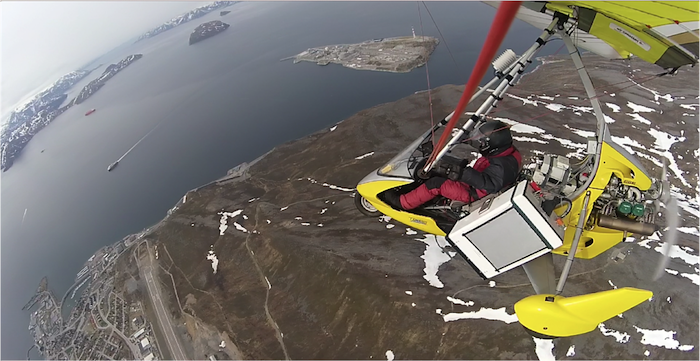
Ultra-light aircraft ULA) flight making lidar aerosol measurements above Hammerfest airport as part of the PARCS aerosol-cloud campaign in May 2016, northern Norway. The LNG Gas terminal Melkøya is visible on the right.
Photo credit: Franck Toussaint (ULA pilot).